


Healthcare Information

Learn about radiotherapy for primary breast cancer, including what it is, when you might have it and what to expect.
Radiotherapy uses high-energy x-rays to destroy cancer cells.
It’s given to destroy any cancer cells that may have been left in the breast or chest and surrounding area after surgery. You may hear this called adjuvant radiotherapy.
Your treatment team or breast care nurse will explain when you’ll start radiotherapy.
If you’re having after surgery, you’ll usually have radiotherapy after the chemotherapy.
If you don’t need chemotherapy, you’ll usually start radiotherapy 6 to 8 weeks after your surgery.
Radiotherapy may be delayed for a medical reason, for example if you need to wait for a wound to heal or if you develop a seroma (a collection of fluid that sometimes forms under a wound after an operation).
You can speak to your treatment team if you’re worried about waiting times for radiotherapy.
Radiotherapy may not be suitable if:
A treatment that destroys cancer cells using anti-cancer drugs. It works by affecting their ability to divide and grow.
When deciding which areas to treat and how, your treatment team will consider:
If you’ve had , you’ll usually have radiotherapy to the remaining breast tissue on that side.
Your treatment team may consider giving radiotherapy to the area of your breast or chest where the cancer was removed, rather than the whole breast area. This is known as partial breast radiotherapy. It may be considered if the risk of the cancer coming back is low and you’re going to be taking hormone (endocrine) therapy for at least 5 years.
Research has shown that partial radiotherapy is just as effective as whole breast radiotherapy in certain people.
If the risk of your cancer coming back is very low, you may not need radiotherapy after breast-conserving surgery. Your treatment team will discuss your risk and explain whether you need radiotherapy.
Your treatment team may recommend you have radiotherapy to the chest wall if you’ve had a mastectomy for an invasive breast cancer.
This may be the case if:
If you’re having breast reconstruction, radiotherapy may affect the timing and type of reconstruction.
Radiotherapy can be given to the lymph nodes under the arm to destroy any cancer cells that may be there.
It may also be given to the lymph nodes in the lower part of the neck around the collarbone, or in the area near the breastbone (sternum).
If your treatment team recommends you have radiotherapy to the lymph nodes, they will explain why.
The removal of the cancer with a border (margin) of normal breast tissue around it. Also called wide local excision or lumpectomy.
The system used to classify cancer cells according to how different they are to normal breast cells and how quickly they are growing.
The size of the cancer and how far it has spread.
Radiotherapy can be given in several ways and at different doses.
The total dose of radiotherapy is split into a course of smaller treatments. These are called fractions.
The x-rays from radiotherapy for primary breast cancer do not make you radioactive. When you leave the treatment room you can safely mix with other people, including children.
External beam radiotherapy (EBRT) is the most common type of radiotherapy used to treat primary breast cancer.
X-rays are delivered by a machine which directs beams of radiation at the breast or chest area.
Intensity modulated radiotherapy (IMRT) is a way of giving external beam radiotherapy.
The dose of radiotherapy can be varied (modulated), allowing different amounts of radiation to be given to different areas.
IMRT is not available in all radiotherapy treatment centres.
This is a type of IMRT. The radiotherapy machine rotates round the area being treated, continuously changing the shape and intensity of the radiation beams.
The following types of radiotherapy are less commonly used and not widely available:
However, your treatment team may discuss them if they’re suitable for you.
Your treatment team will explain how long you will have radiotherapy for.
You’ll usually have radiotherapy for between 5 and 15 days. This will usually be Monday to Friday. You’ll have a break at weekends. Most hospitals do not give radiotherapy on bank holidays.
Depending on local guidelines and your personal situation, you may be given radiotherapy in a slightly different way. For example, you may have a smaller daily dose over a longer period of time.
You’ll have your treatment at hospital as an outpatient, so you can go home the same day. Radiotherapy is not available in every hospital, but each breast unit is linked to a hospital that has a radiotherapy department. You may have to travel for treatment.
Your appointments may be arranged for a similar time each day so you can settle into a routine, but this isn’t always possible.
It’s important to attend all your radiotherapy appointments and avoid any gaps in treatment as much as possible. If you have a holiday booked, tell your treatment team or therapeutic radiographer so you can decide what arrangements to make together.
You may have radiotherapy for longer if you need an extra amount or dose (called a boost). Your treatment team may recommend a boost of radiotherapy to an area where invasive breast cancer was removed following radiotherapy to the whole breast.
The boost is usually given as 4 to 8 extra sessions at the end of treatment. However, it can be given at the same time as radiotherapy to the breast.
Your treatment team will explain the details of your treatment, its benefits, risks and potential side effects. You will then be asked to sign a consent form.
You may be asked if you’d like to take part in a clinical trial.
If you’re worried about what will happen and how radiotherapy works, you can speak to your treatment team. They may be able to arrange for you to see the radiotherapy suite before your treatment.
You will have a treatment planning session before your treatment with radiotherapy begins.
Treatment planning helps identify the exact area to be treated and the most effective dose of radiation. This also helps to limit the amount of radiation to surrounding tissue.
The planning session will usually take between 15 minutes and an hour. Treatment planning is usually done using a CT (computerised tomography) scanner.
You’ll need to lie very still while your arms are positioned above your head and supported in an arm rest. You may be asked to raise only the arm on the side being treated. You may be asked to hold your breath for a short period of time.
If holding the position feels uncomfortable, let your treatment team know. They may be able to offer you a back support or knee support to make you more comfortable.
Your whole chest area may be exposed during both your planning and radiotherapy sessions. There may also be multiple people in the room while the equipment is being set up. Some people find this uncomfortable. If you’re nervous, speak to the therapeutic radiographers who can try to help you feel more comfortable.
Tell your treatment team or therapeutic radiographer before or during your planning appointment if:
If you have any issues with your mobility, you can discuss this with your treatment team. They can look at making adjustments, such as changing your position or helping you on and off the treatment couch.
Once the area of treatment has been decided, it needs to be marked. This is so you can be positioned precisely for each treatment.
To do this, 3 tiny dots of permanent ink (tattoos) are made on your skin.
If you don’t want permanent tattoo markers, you should be given the option to have semi-permanent marker dots applied instead. If you choose this option, you may need to be more careful when washing so they don’t fade away.
A newer technique called surface guided radiation therapy (SGRT) involves using 3D imaging to help position you. This doesn’t use tattoos or semi-permanent ink to mark the area. However, it’s not available in all hospitals. Your treatment team will let you know if this is an option for you.
Once the planning and marking is complete, your therapeutic radiographer will arrange your first treatment appointment.
Some people prefer to have their radiotherapy tattoos removed after finishing treatment. Tattoo removal is not routinely available on the NHS and the results can vary.
Before you start radiotherapy, you need to be able to move your arm and raise it above your head. This is so treatment can be given to your whole breast or chest area.
After surgery it can be difficult or painful to lift your arm above your head and keep it there. You will be given exercises to help you regain arm and shoulder movement.
If your arm movement isn’t improving, it’s important to talk to your breast care nurse or ask to see a physiotherapist as early as possible.
You can also take pain relief before each appointment to help you feel more comfortable holding the position.
The therapeutic radiographers treating you will check how you are before each treatment. They can also answer any questions you have. They’ll give you advice on side effects and arrange an appointment with your treatment team if necessary.
You’ll be asked to undress above the waist. You may find it helpful to wear a top that’s easy to take off and put on.
You will usually be given a gown to wear.
You’ll lie down on the treatment couch with your arms or arm above your head. If you’re wearing a gown, the therapeutic radiographer will adjust it to expose the treatment area. They’ll help position you carefully so you’re in the same position each time you have treatment.

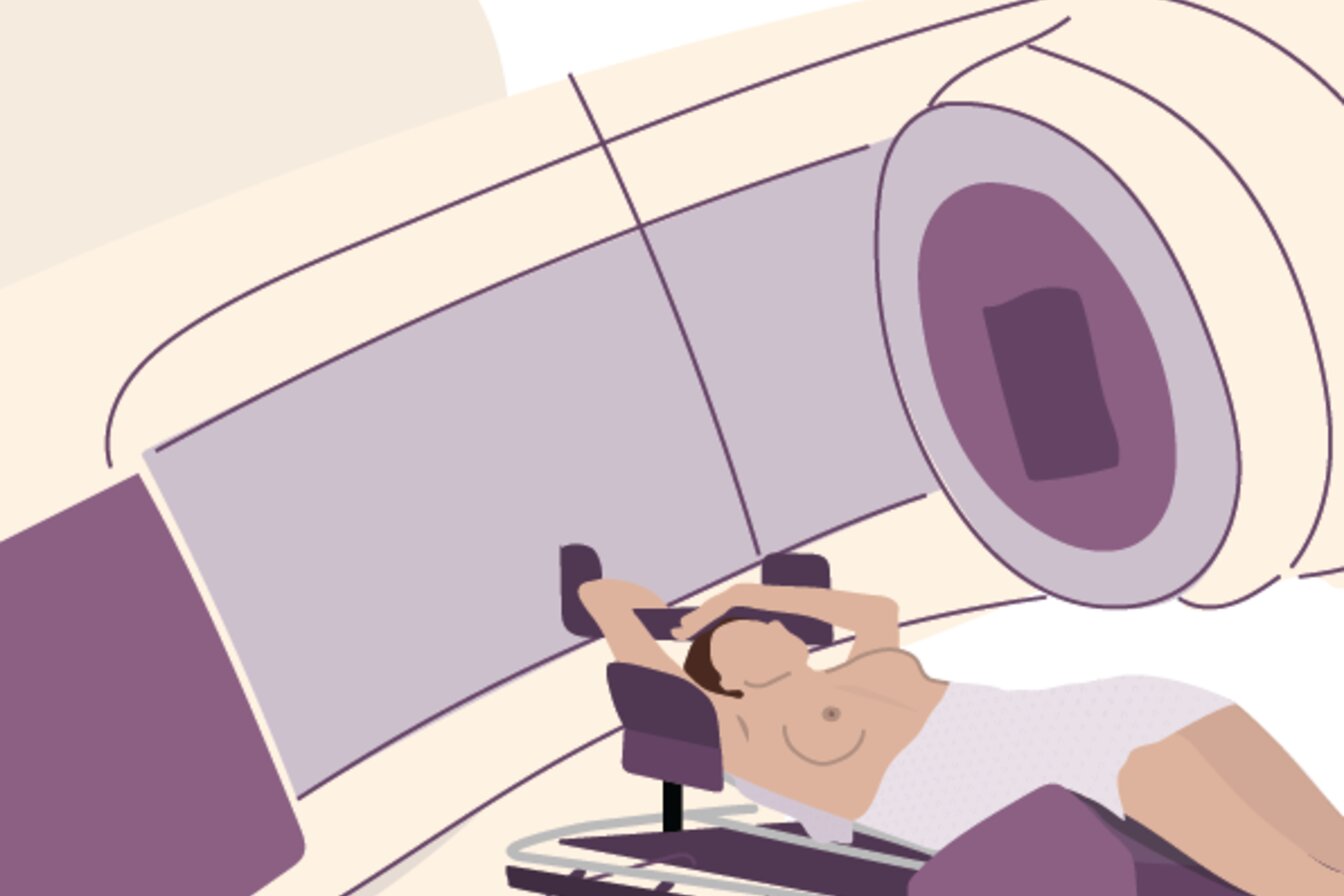
You’ll need to remain still during treatment. You can breathe normally unless you're asked to do the breath hold technique.
Radiotherapy to the breast or chest wall is usually given from a number of different angles. The therapeutic radiographer will reposition the machine for each angle. This is done remotely from outside the room.
Although you’ll be alone in the room, cameras will allow the therapeutic radiographers to watch you on a television screen. Most radiotherapy departments also have an intercom system so you and the therapeutic radiographers can talk to each other and stop the treatment if needed.
The radiotherapy machine makes a buzzing noise while it’s on. The machine may come quite close to you but it won’t touch you. You won’t feel the radiotherapy being given.
The treatment itself only takes 2 to 3 minutes. Your whole appointment is likely to take 15 to 30 minutes, but most of that time will be spent getting you into the correct position before the treatment starts.
You can watch videos about what to expect during radiotherapy on the Radiotherapy UK website and the RESPIRE Project website.
A technique called deep inspiration breath hold (DIBH) can help protect the heart from being affected by radiotherapy given to the left side.
It involves taking a deep breath in and holding it for a short time. The aim of this is to lift your ribs up and outward, away from your heart.
DIBH is done both at the treatment planning appointment and at each external beam radiotherapy (EBRT) appointment.
If you need to use breath hold, you will be given simple coaching instructions and time to practise the technique. Your therapeutic radiographer will tell you how and when to hold your breath.
Not everyone having their left side treated will need, or be able to use, this method. Your treatment team or therapeutic radiographer can talk to you about other ways to protect your heart.
You can watch a video about what to expect if you will be using the breath hold technique during radiotherapy on the RESPIRE Project website.
Like any treatment, radiotherapy can cause side effects. Everyone reacts differently to treatment and some people have more side effects than others.
Find out more about the side effects of radiotherapy.
Some people wonder whether certain supplements, such as vitamins, herbal remedies or probiotics, might help ease their symptoms or treatment side effects. But there’s conflicting evidence about the safety and effectiveness of many products.
Supplements do not have to comply with the same regulations or go through the same rigorous testing as conventional medicines. They may also affect how certain cancer treatments work, such as chemotherapy and radiotherapy.
Tell your treatment team about any medications you’re taking or considering taking. This includes:
The evidence isn’t clear whether high-dose antioxidants (including vitamins A, C and E, co-enzyme Q10 and selenium) are harmful or helpful during your radiotherapy. Because of this uncertainty, many treatment teams recommend that you do not take high-dose antioxidant supplements during radiotherapy.
You can also find information about supplements on the Memorial Sloan Kettering Cancer Center website.
Travelling to and from the hospital for your radiotherapy, or paying for parking, can be expensive.
If you think going to appointments will be difficult because of the cost or other travel issues, talk to your breast care nurse or treatment team to find out what help is available. If you have a local cancer information centre, they can tell you if any financial help or voluntary community transport is available in your area.
Macmillan Cancer Support has more information about help with the cost of cancer on its website. You can also find out about help with health costs on the NHS website.
Once you’ve completed your radiotherapy treatment, it may take some time to get back to your everyday routine. Try not to push yourself too hard in the early days and weeks after your treatment.
You may continue to feel tired (fatigue) for some time. Tiredness sometimes gets worse after radiotherapy finishes, but you should start to feel better with time. For some people this can take several months and sometimes longer.
Find out more about life after breast cancer treatment.
At the end of your hospital-based treatment, you may continue to be monitored to check how you are recovering. This is known as follow-up. People are followed up in different ways.
If you have any questions or concerns between appointments or after your radiotherapy has finished, you can talk to your breast care nurse or treatment team.
If radiotherapy is your last hospital-based treatment and the end goal you’ve been focussing on, getting there can feel like real progress. However, it’s also natural to feel isolated, low or worried, especially when the routine of your regular hospital appointments stops.
Your breast care nurse can direct you towards support. You can also call our free helpline – please see below.
You may also like to speak to other people who have had radiotherapy on our online forum. We can also match you with a trained volunteer with a similar experience to you through our Someone Like Me service – see below.

It can be difficult to talk to someone in person about breast cancer concerns. Explore other ways you can ask a question.
If you have any concerns about breast cancer, or just want to talk, our specialist nurses are here for you.
Lines open: Monday to Friday - 9am to 4pm; Saturday - 9am to 1pm

Find out the support we offer for people affected by breast cancer.